
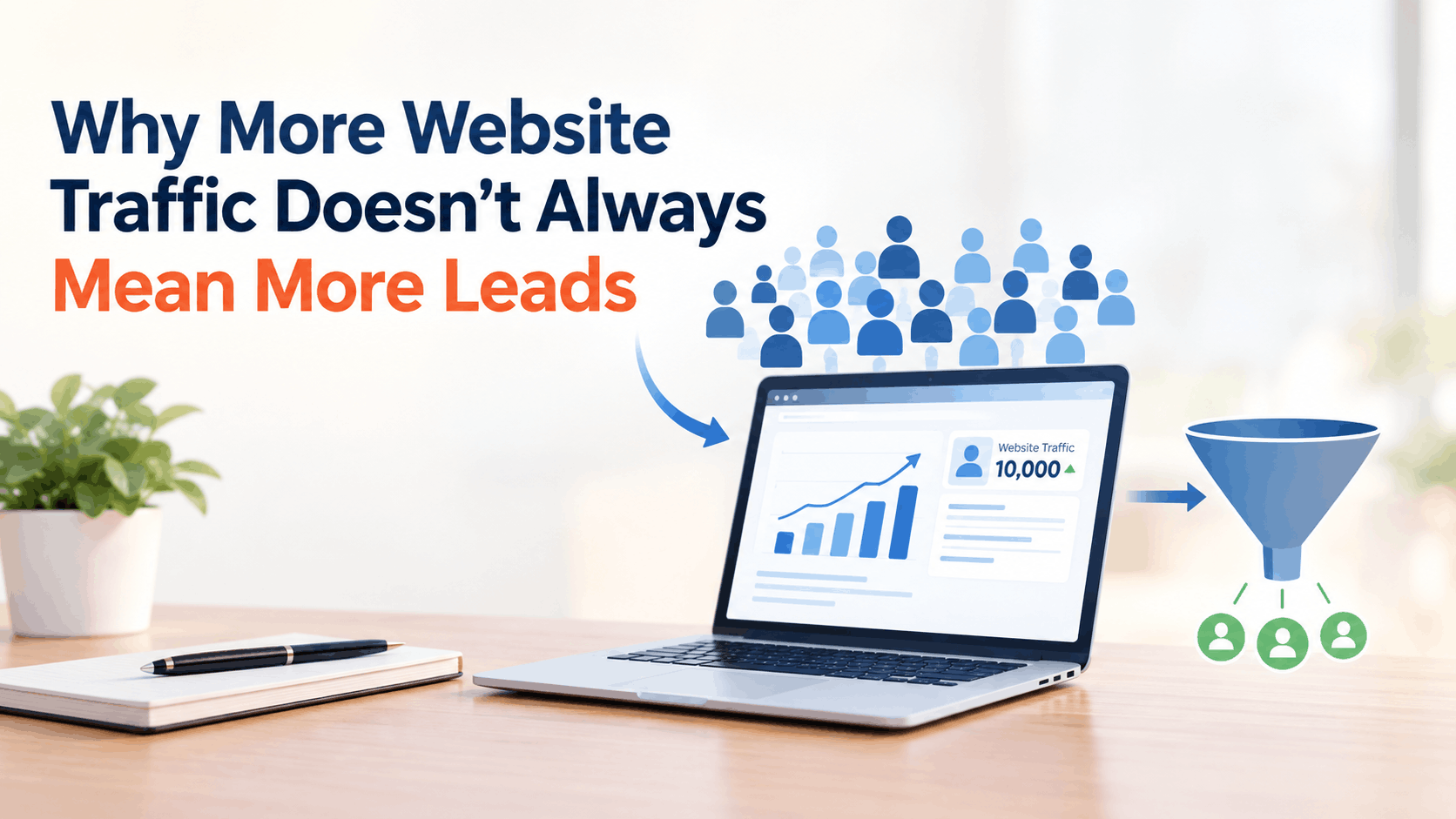
Website traffic is one of the easiest marketing metrics to understand. When a site grows from 2,000 visitors per month to 4,000, it feels like the marketing must be working. Sometimes it is, but traffic growth alone does not tell you whether the business is generating more qualified leads, customers, or revenue.
One of the biggest mistakes I see businesses make is assuming more visitors automatically mean more opportunities. Traffic can grow significantly while lead volume stays flat or lead quality declines. The more important questions are whether the right people are reaching the site, whether they trust what they find, and whether the site gives them a reason to take the next step.
My name is Ali Pourvasei, and I have worked through this exact pattern with business owners in many industries. Traffic creates opportunity. The rest of the marketing system determines whether that opportunity becomes business, and that is where the diagnosis needs to happen.
Traffic Is a Marketing Metric, Not a Business Outcome
Traffic is useful because it shows people are finding your website and helps measure whether SEO, Google Ads, content marketing, social media, and referrals are creating visibility. The problem begins when traffic becomes the goal instead of one metric inside a much larger customer acquisition process.
Consider two service businesses. One website receives 10,000 visits per month and generates 40 qualified inquiries, while another receives 3,000 visits but generates 90. The first looks more impressive in an analytics report, but the second is clearly better at turning visibility into business. This is why I encourage owners to evaluate marketing by the quality of the opportunities it creates and the results that follow, not by sessions alone.
Search Intent Explains Most of the Traffic-to-Lead Gap
Not every visitor arrives with the same intent. Someone searching for general information may be months from a decision, while someone searching for a specific service in their city could be ready to call the same day. Both count equally in Google Analytics, but their business value is very different. A dentist might get thousands of visits to an article about tooth sensitivity while far fewer people reach a page about emergency dental care in Los Angeles. A contractor could rank nationally for a broad home improvement topic even though the company only serves one region. An ecommerce business may attract heavy informational traffic with no matching lift in sales.
None of that informational traffic is worthless. Educational content builds authority, introduces a brand to future customers, attracts links, and supports long-term SEO. The mistake is assuming every additional visitor carries the same likelihood of becoming a lead. When I review a site with strong traffic and disappointing lead volume, search intent is the first thing I examine, because it usually explains more of the gap than design does.
This is also why SEO built around search volume can mislead. A keyword with 10,000 monthly searches is not automatically more valuable than one with 200, because the smaller term may attract people much closer to a purchasing decision. Effective SEO connects keyword selection with intent, service relevance, and commercial value, then uses informational content to support the larger customer journey rather than chasing volume for its own sake.
Friction, Trust, and Messaging Decide Whether Qualified Visitors Convert
Sometimes the traffic is exactly what the business wants, and the website itself becomes the obstacle. Visitors arrive with legitimate interest and run into slow load times, confusing navigation, difficult forms, unclear calls to action, or a poor mobile experience. Owners rarely notice because they already know their own site. A new visitor may be comparing several companies within minutes on a phone, and a number buried in the footer or a form with too many fields costs real opportunities once hundreds of people hit it.
Friction is the visible problem, but trust is usually the deeper one. Button colors and form placement can matter, but they rarely fix a credibility gap. People contact a business because they believe it can solve their problem. A law firm builds that confidence through attorney experience, case results, and client reviews. A medical practice relies on provider credentials, patient reviews, and easy scheduling. An ecommerce store depends on product reviews, shipping transparency, and return policies. The signals change by industry, but a polished site without credibility still will not convert consistently.
The final piece is messaging. Many professionally designed sites underperform because the copy is about the company rather than the visitor’s problem. A homeowner with a broken air conditioner wants to know it can be fixed quickly and reliably. A business owner facing an IRS issue wants possible solutions, not a company history. A founder researching trademark protection wants to know the attorney understands a growing business. Credentials still matter, but they persuade far more when the visitor can see how that expertise applies to their situation.
More Traffic Magnifies an Existing Conversion Problem
Increasing traffic does not fix a website that converts poorly. It sends more people through the same inefficient process. If a site converts a very small percentage of 5,000 monthly visitors, doubling the traffic produces some additional leads, but the weakness remains, and improving the experience for visitors already arriving often creates a better return than paying to acquire more.
This matters most in Google Ads, where every click has a direct cost, so raising the budget behind a confusing landing page simply accelerates wasted spending. SEO faces the same limitation, because additional rankings cannot compensate for unclear positioning or a site that does not persuade visitors to act.
Lead Quality Is More Important Than Raw Conversion Volume
Even a higher conversion rate does not automatically mean a campaign is performing better. A site can generate far more form submissions while creating more work for the sales team and no more customers. This happens when marketers optimize for the easiest possible conversion. Shortening a form or broadening targeting may increase inquiries while also increasing the share of people outside the service area, unable to afford the service, or simply not serious.
That is why I evaluate marketing around qualified opportunities rather than raw leads. Website analytics, call tracking, Google Ads conversion tracking, CRM records, and actual sales outcomes should be connected wherever possible. The closer a business gets to knowing which activities generate revenue, the less likely it is to scale something that only looks productive.
Channel-Level Data Tells a More Useful Story Than Total Traffic
Looking only at total traffic hides what is happening across channels and pages, because organic visitors, paid clicks, branded searches, and referral traffic all behave differently. A site might see a 40 percent increase in organic traffic without a matching increase in leads, which looks disappointing until a deeper review shows most of the new traffic came from blog content while high-intent service pages still increased qualified inquiries at a healthy rate. That changes the interpretation completely, and good reporting should explain those differences rather than compressing every visit into one number.
Paid search is also one of the fastest ways to surface a conversion problem. SEO takes time to generate enough traffic for patterns to emerge, while a Google Ads campaign produces behavioral data almost immediately. If people search high-intent terms, click relevant ads, land on a page built for that service, and consistently leave without acting, something deserves investigation, whether that is pricing, messaging, credibility, or the offer itself. Those insights should not stay locked inside the ad account; what a business learns from paid search can improve service pages, organic content, and calls to action across the whole site.
AI Search Makes Traffic an Even Less Complete Measurement
AI-driven search is making website traffic an even less complete measure of performance. Google AI Overviews and platforms such as ChatGPT, Gemini, Claude, and Perplexity can answer questions directly and mention businesses without sending users to every source involved. That does not make traffic irrelevant. It means businesses should think more broadly about how visibility influences decisions, using brand mentions, branded searches, direct visits, assisted conversions, AI referral traffic where measurable, and overall acquisition trends for context.
This shift also raises the importance of genuine authority over clicks alone. Businesses need useful content, clear expertise, strong brand signals, structured information, reputable third-party mentions, and a consistent presence that helps both people and AI systems understand who they are. A business cited in an AI answer may never see that interaction in a traffic report, but it still shapes who eventually picks up the phone.
Conversion Optimization Begins With Finding the Real Bottleneck
When a business tells me it wants more website leads, redesigning pages or buying more traffic is rarely the right first step. The priority is finding where the current system breaks down. One business may genuinely need more SEO or paid exposure. Another may get plenty of traffic from visitors whose intent does not match its services. A third may attract qualified prospects who leave because the site does not establish trust, and a fourth may generate plenty of inquiries that never become viable sales.
Each situation requires a different solution, and treating all of them as a traffic problem produces more spending without fixing the actual weakness. Good digital marketing begins with diagnosis before tactics, and every business needs a strategy built around its own bottleneck rather than a generic playbook.
Frequently Asked Questions
What is a good website conversion rate?
There is no universal rate every business should target, since performance varies by industry, traffic source, price point, and what counts as a conversion. A more useful benchmark combines your own history with the quality and profitability of the leads generated.
Should I increase traffic or improve conversions first?
Start by identifying the bottleneck. If very few qualified prospects reach the site, acquisition may deserve priority. If high-intent traffic is already arriving but visitors rarely make contact, improving the site and conversion process usually creates more value before spending more on traffic.
Why does my blog generate traffic but very few leads?
Blog readers usually have informational intent rather than an immediate need to hire or buy. That traffic still builds authority, strengthens SEO, and influences future decisions, so judge blog performance within the broader customer journey rather than by immediate form submissions.
Can better SEO improve lead quality?
Yes, when the strategy prioritizes relevance and intent over volume. Improving visibility for specific services, locations, and decision-stage searches attracts people far more closely aligned with what the business actually offers.
How can I tell which traffic is producing customers?
Accurate conversion tracking is the starting point, but go beyond basic analytics wherever possible. Connecting Google Analytics, Google Ads, phone calls, form submissions, CRM records, and closed sales shows which channels and searches actually create qualified opportunities and revenue.
Better Marketing Starts With Better Measurement
More website traffic can be a positive sign, but it should never be confused with business growth on its own. The real objective is attracting the right visitors, giving them a reason to trust the business, creating an easy path to action, and turning that attention into qualified opportunities. Search intent, user experience, messaging, lead quality, and sales outcomes all form the complete picture, and as AI-driven search changes how people discover companies, sessions and clicks alone will tell you even less.
Before investing more in SEO, Google Ads, content, or traffic of any kind, identify where the funnel is actually losing opportunities. More traffic is valuable when the rest of the system is ready to convert that visibility into measurable results.
As Co-Founder of LAD Solutions, I have spent years helping businesses evaluate how SEO, Google Ads, website performance, and conversion strategy work together. If your website is attracting visitors but not producing the qualified leads you expected, schedule a consultation or request an SEO, Google Ads, or website performance audit, and we will help you find where the disconnect is and build a strategy around your business rather than a template.
