
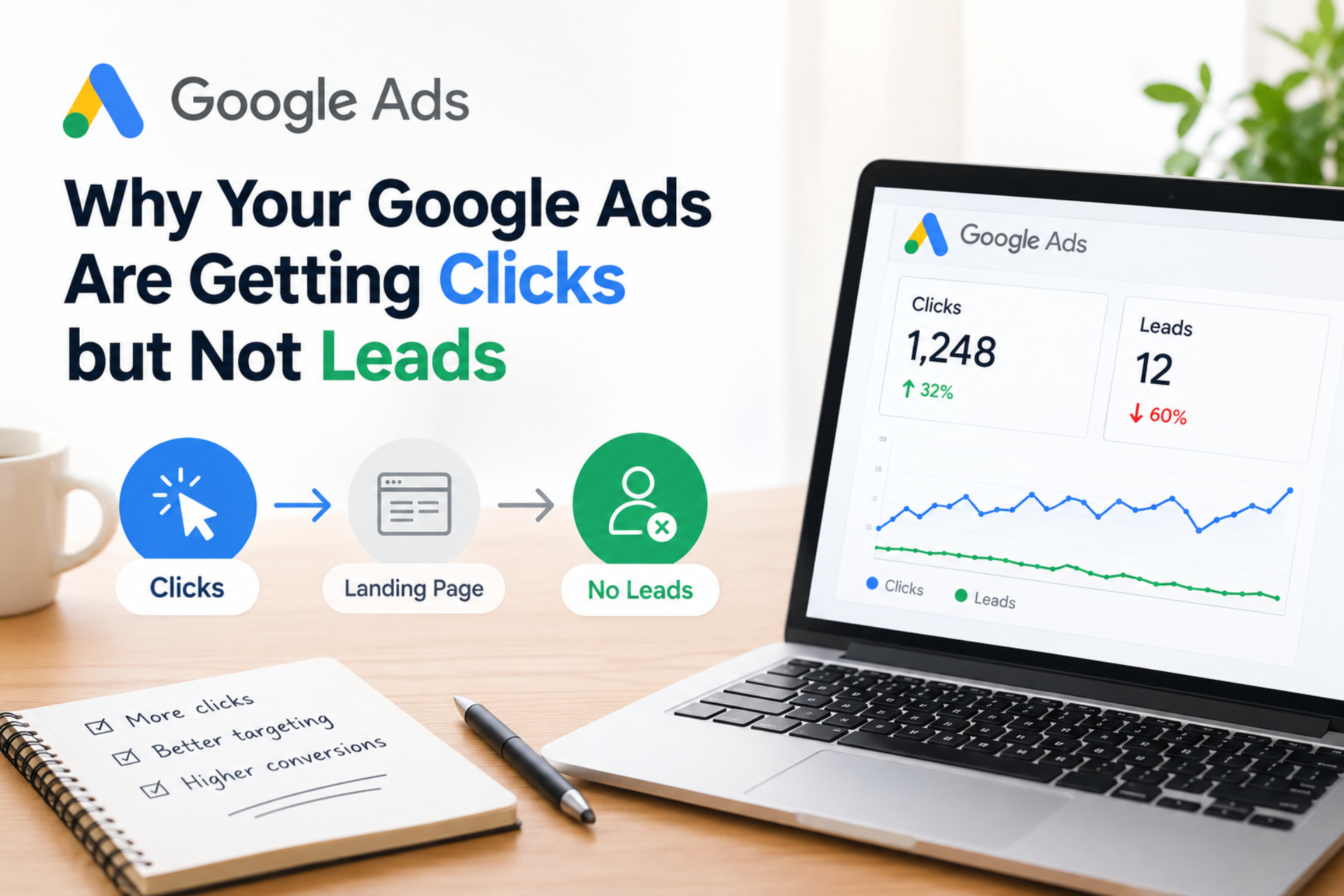
Clicks coming into a Google Ads campaign without enough leads is frustrating. People are searching, seeing the ads, and visiting the website, yet the phone is not ringing and the forms are not arriving.
The instinct is to blame Google Ads itself: the clicks are bad, the competition is too expensive, or paid search does not work for this industry. My name is Ali Pourvasei, and after auditing many campaigns in this situation, I can tell you the real problem is usually more specific. Somewhere between the search and the customer’s decision to make contact, the campaign is losing qualified prospects.
Diagnosing that means looking past clicks and cost per click. A successful Google Ads campaign depends on the searches targeted, the ad message, the landing page, conversion tracking, the offer, and what happens after someone becomes a lead. If one piece is weak, the campaign generates activity without results.
Clicks Do Not Automatically Represent Qualified Demand
A click tells you someone found an ad relevant enough to visit the website. It does not tell you whether that person was a realistic customer. The searches that trigger an ad can extend well beyond the exact keywords an advertiser enters, because modern keyword matching considers meaning and context, and broader match types reach a wider range of related searches.
A company selling commercial equipment may attract people looking for repairs, used units, jobs, or replacement parts when the campaign is meant to sell new equipment. All of them can click, and only a fraction are the audience the business wants. This is why I never judge a campaign on whether traffic is increasing; the first question is whether it is attracting the right traffic.
Search Terms and Negative Keywords Show Where the Budget Really Goes
Keywords and search terms are not the same thing. Keywords are the targeting instructions inside the account, while search terms are the actual words people typed before an ad appeared, and the search terms report shows which searches triggered ads and how they performed. That difference explains a lot of wasted spend. A law firm targeting a keyword around business attorneys may find clicks from people seeking free legal advice, law school information, job openings, or document templates. The keyword looks relevant, but the intent behind those searches has nothing to do with generating consultations.
Reviewing search terms regularly closes the gap between targeting and intent and reveals how prospects actually describe their needs, which improves ad copy and landing pages too. Once irrelevant patterns are visible, negative keywords stop the campaign from continuing to pay for them. A contractor may need to exclude searches for jobs, salaries, training, or DIY instructions, while an ecommerce company might exclude manuals, parts, or wholesale inquiries. The goal is better demand reaching the site, not the most restrictive list possible, because excluding too aggressively removes legitimate opportunities along with the noise.
The Ad Copy May Be Attracting the Wrong Click
Sometimes targeting is reasonable but the ad itself draws the wrong visitor. Copy that is vague, overly broad, or written to maximize click-through rate attracts people who are curious but unlikely to buy. An ad promising “Affordable Legal Help” may produce strong engagement, but affordable means very different things to different people. A more specific ad naming the type of legal service, the geographic area, and the intended client generates fewer clicks and stronger leads.
The job of ad copy is not to convince everyone to click. It is to attract the right people while giving less relevant searchers enough information to decide the business is not for them. A lower click-through rate is fine when the people who do click are far more qualified.
The Landing Page and Website Have to Finish the Conversation
Once the right person clicks the right ad, the landing page needs to continue the conversation. One of the most common problems I see is a disconnect between the search, the ad’s promise, and the page: someone searches for a specific service, sees an ad about it, and lands on a generic homepage. A strong landing page immediately confirms the visitor is in the right place, explains the service, addresses likely concerns, establishes credibility, and offers a clear next step. When someone searching for a dentist or HVAC contractor opens several results in a row, the competitor with the clearer page wins the lead even when your click was legitimate.
Not every Google Ads problem can be fixed inside Google Ads. A campaign can deliver highly relevant visitors to a website that still fails to persuade them. Outdated design, weak reviews, vague service descriptions, missing credentials, slow pages, and a complicated contact process all suppress conversions. Trust signals vary by industry, from attorney case results to provider credentials to return policies, but the principle holds everywhere. Those same signals increasingly shape what Google AI Overviews and AI assistants say about a business when prospects research before clicking an ad, so a site that establishes trust is doing double duty.
Mobile deserves its own look. Many paid search interactions happen on phones, where a desktop-friendly form becomes frustrating and a visitor needs several pages to find a phone number. Owners review their sites on large monitors and assume the experience works, which is not what a prospect sees from a jobsite. If mobile traffic is strong but mobile conversions are weak, the experience is the problem.
Conversion Tracking May Be Telling the Wrong Story
Before deciding a campaign is not producing leads, make sure the tracking itself is accurate. Google Ads relies on conversion actions to understand what happens after people interact with ads, and the setup has to be correct for the data to mean anything. I have seen accounts where a page visit counted as a lead, duplicate conversions inflated performance, phone calls were never tracked, or key forms were missing from measurement entirely. In every case, optimization decisions were being made from misleading information.
Tracking problems cut both ways: a campaign can look stronger than it is because meaningless actions are counted, or weaker because legitimate calls are not recorded. Before changing targeting or raising the budget, verify that measurement reflects the actions that matter to the business.
Lead Quality and Geography Matter More Than Lead Volume
Another common mistake is optimizing around raw lead count. Imagine Campaign A produces 40 leads and Campaign B produces 20, so A looks like the winner, until the sales team reports that only five of A’s leads were qualified while 15 of B’s became real opportunities. The smaller campaign is creating far more value, which is why lead quality has to be connected back to advertising data. A form submission is not a success simply because Google Ads recorded a conversion; the best decisions come from knowing which keywords eventually produce customers, not the cheapest forms.
Geography creates the same illusion. A local service business can receive clicks that look relevant by keyword but come from outside its service area, and multi-location businesses create overlap when campaigns are not structured around each location’s market. A campaign can appear to have a keyword problem when the real issue is that the right search is happening in the wrong place. Review geography alongside search terms, because the right search still has little value if the business cannot serve that customer.
More Budget Does Not Fix a Conversion Problem
When a campaign produces too few leads, increasing the budget feels like the easiest fix, but that only works when the campaign is already efficient. If irrelevant searches, weak landing pages, broken tracking, or low-quality leads are the real problem, a bigger budget just gives those problems more money to work with. I prefer to diagnose the bottleneck first, then direct additional spend toward the searches, ads, and pages that have already demonstrated value.
The problem can also continue after the lead arrives, and Google Ads gets blamed for failures that happen after marketing has done its job. A qualified call comes in and the opportunity is lost because nobody answers, the lead waits a day for a response, or a competitor provides a better experience. For high-intent searches like an emergency plumber, prospects contact several businesses within minutes, and response time becomes part of marketing performance even though it happens outside the ad platform. Good attribution follows inquiries through to appointments and sales rather than stopping at the form.
A Strong Google Ads Audit Follows the Customer Journey
When I audit a campaign with clicks but few leads, I do not start by changing bids or adding keywords. I follow the customer’s path from the first search to the business outcome: whether the right searches trigger ads, whether the ad communicates the service accurately, whether the landing page matches intent, whether the website establishes trust, and whether tracking records the right actions. The final step is what happens to the leads that do come in, because if the campaign produces legitimate prospects who never become customers, the fix lives in the sales process, pricing, or response time rather than the ad account. Every business finds its bottleneck in a different place, which is why diagnosis beats assuming the campaign needs more traffic.
Frequently Asked Questions
How many clicks should Google Ads generate before I expect a lead?
There is no universal number, because conversion rates vary widely by industry, keyword intent, competition, and landing page quality. Rather than a generic benchmark, check whether the campaign is getting enough relevant traffic for a meaningful sample and whether those searches represent realistic customers.
Why am I paying for irrelevant Google Ads clicks?
Your keywords may be matching more broadly than expected, or your negative keyword list may not yet exclude enough irrelevant intent. The search terms report shows the actual searches generating clicks and the patterns that should be refined or excluded.
Should every Google Ads campaign use a dedicated landing page?
Not necessarily, but the destination should closely match the search and the ad. A strong existing service page often works well, while a generic homepage creates friction for specific searches. Decide on relevance and conversion performance, not a universal rule.
Can Google Ads work if my website is outdated?
Advertising can still generate traffic, but an outdated or hard-to-use site sharply reduces the value of those visits. If visitors do not trust the business or struggle to make contact, fixing the website usually beats increasing ad spend.
Should I pause Google Ads if I am getting clicks but no leads?
Not automatically. First determine whether the problem is targeting, search intent, landing pages, conversion tracking, geography, or lead handling. Once the bottleneck is identified, you can decide whether to optimize, restructure, reduce spend, or pause the areas not producing value.
Better Google Ads Performance Starts With Better Diagnosis
A campaign receiving clicks without enough leads is not proof that Google Ads does not work. It is evidence that something between the search and the sale needs closer examination. The strongest campaigns align every stage of that journey: real commercial intent, clear ads, relevant pages, trust, easy conversion, accurate measurement, and leads that actually become customers. That is why clicks, impressions, and even cost per lead should never be read in isolation. The objective is qualified opportunities at economics that make sense, not conversions piling up in a dashboard.
Before increasing your budget, make sure the campaign you already have is attracting the right people and giving them a strong reason to become customers. Better performance usually begins not with spending more, but with understanding where the process is breaking down.
As Co-Founder of LAD Solutions, I have spent years evaluating Google Ads campaigns across industries and seeing how targeting, landing pages, tracking, and lead quality affect one another. If your campaigns are generating clicks but not enough qualified leads, request a Google Ads audit and we will review the account, the website, and the conversion path together to find where potential customers are being lost.
